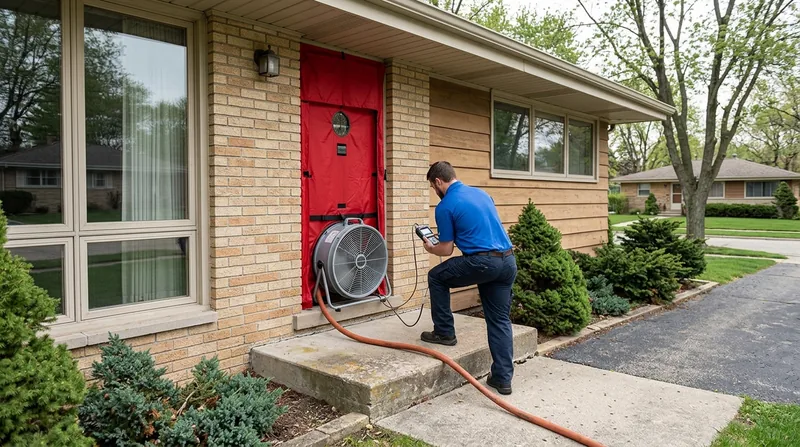




Air sealing in Rockford stops the warm moist air escaping through your attic floor and rim joists during the long heating season. Rockford's housing stock spans three eras: early-1900s balloon-frame homes near downtown with open rim joists, mid-century ranches with settling attic insulation, and newer subdivisions in Loves Park, Machesney Park, and Roscoe built to current code but still leaving gaps at top plates and penetrations. In zone 5A climate with cold winters, heating bills track with how tight your ceiling and rim joist air barrier is, not just how thick the insulation looks. We find and seal those air leaks at the attic floor, top plates, and mechanical penetrations to stop drafts and hold heat where it belongs. The result is lower heating bills, fewer cold spots upstairs, and a basement that stops losing warmth through the rim joist.
Why Air Sealing Matters in Rockford's Older Homes and Newer Subdivisions
Heating and cooling loss in Greater Rockford doesn't come from thin insulation alone. It comes from air leaks at the ceiling plane and the rim joist, where warm moist air escapes upward and outward during winter, and cold outside air finds its way back in. Early-1900s homes near downtown carry balloon-frame wall cavities and open rim joists that have leaked heat for decades. Mid-century ranches spread across the city sit over full basements where the band joist was never sealed, leaving the first floor cold underfoot even when the furnace runs hard. Newer homes in Cherry Valley, Belvidere, and Winnebago were built to IECC code, but builder-grade batts still leave gaps at top plates and around electrical boxes, ductwork, and plumbing stacks that rise through the attic.
- We identify air leaks at the attic floor, rim joists, top plates, and mechanical penetrations using visual inspection and thermal imaging where the issue is not obvious.
- We seal those leaks with closed-cell or open-cell spray foam, which expands to fill voids and creates a continuous air barrier that fiberglass batts cannot match.
- We focus on the ceiling plane first, because that is where the greatest temperature and pressure difference occurs in winter, and where the most air movement happens.
- We verify that attic ventilation meets code before we seal anything, because improper ventilation can trap moisture and cause rot in the roof deck.
- We do not seal over wet substrates, contaminated insulation, or active roof leaks; we fix the moisture first or we walk away.
The result is a tight ceiling and rim joist air barrier that cuts heating costs and stops the drafts that no amount of thermostat adjustment can fix.
Key info: In Rockford and Loves Park, a common complaint is cold bedrooms upstairs even when the furnace is running. This happens because warm air leaks out through the attic floor at top plates, electrical boxes, and ductwork penetrations. Sealing those leaks stops the air movement and makes the second floor comfortable again without raising the thermostat.
For more detail on how spray foam insulation works in attics, see our attic spray foam insulation page. For rim joist and basement applications, visit our rim joist and band joist page.
For official guidance on attic ventilation and thermal barriers in Rockford, check the City of Rockford Development Services website, which lists the building code in force at your address and the permit requirements for attic work.
How We Seal Air Leaks in Rockford Homes: Our Process
Air sealing is not a one-size-fit-all job. The approach depends on whether you have an attic, a sealed roof deck, a crawl space, or rim joists exposed in a basement. We inspect first, identify where air is moving, and then choose the right foam type and application method for your space. Closed-cell foam is denser and holds an R-value of 6 per inch, making it ideal for rim joists and tight spaces where you need both air sealing and insulation value. Open-cell foam is lighter, less dense, and cheaper, making it the right choice for attic floors where you are stacking foam on top of existing insulation or where you need sound dampening alongside air sealing.
- We schedule a free estimate and walk your attic, crawl space, or basement rim joist to map the air leaks and measure the scope.
- We provide a written estimate that names the foam type, the thickness we will apply, the R-value you will get, and the cost.
- We set up mechanical ventilation during the spray and cure process to control fumes and ensure safe re-entry within 24 to 48 hours.
- We apply the foam in controlled passes, respecting the manufacturer's thickness limits per pass and drum temperature, so the foam cures correctly and bonds to the substrate.
- We clean up the work area and discuss the re-entry window and any curing smells you may notice in the first day or two.
This step-by-step approach is what separates a professional spray foam installation from a rig-and-run crew that sprays an attic in an afternoon with no ventilation and promises immediate re-entry.
Example: A 1970s ranch in Machesney Park had a finished basement with a cold floor in winter. The rim joist above the foundation wall was never sealed. We sprayed closed-cell foam 2 inches thick on the rim joist and the band board, creating a thermal and air barrier. The basement floor stayed warmer, and the homeowner's heating bill dropped because no conditioned air was leaking into the rim joist cavity.
For more on our approach to attic sealing and insulation, see attic spray foam insulation.
| Approach | Description | Best for |
|---|---|---|
| Attic Floor Sealing with Open-Cell Foam | Light, low-density foam sprayed 2 to 4 inches thick on the attic floor, around top plates, electrical boxes, and ductwork penetrations. Expands to fill gaps and bonds to wood, drywall, and metal. | Attics with existing fiberglass batts, vented attics, and homes where you want to add insulation value and air sealing in one pass. |
| Rim Joist Sealing with Closed-Cell Foam | Dense, high-R foam sprayed 1.5 to 2 inches thick on the band board and rim joist cavity. Creates a thermal break and air barrier that stops heat loss and condensation risk on the basement side. | Basements with cold floors, exposed rim joists, and homes where the band joist was never sealed or is deteriorating. |
| Sealed Roof Deck Sealing with Closed-Cell Foam | Closed-cell foam applied to the underside of the roof deck, creating an air barrier and vapor barrier in one layer. Typical thickness is 1.5 to 2 inches, achieving R-9 to R-12. | Finished attics, cathedral ceilings, and vented attic conversions where you need to seal the roof plane and control interior moisture. |
| Crawl Space Rim and Band Sealing | Closed-cell foam applied to the rim joist and band board in a crawl space, often paired with foam on the foundation wall to create a continuous thermal envelope and air barrier. | Crawl spaces with no encapsulation, homes with dirt or vented crawl spaces, and properties where the rim joist is the primary air leak point. |
Air Sealing Cost in Rockford: What to Expect
Air sealing costs depend on the scope of the work, the foam type, and the accessibility of the areas you want sealed. A small attic floor sealing job, such as sealing top plates and penetrations in a 1,200-square-foot ranch, starts at around $650 to $900. A full rim joist sealing in a basement with 150 linear feet of band board runs $1,200 to $1,800. A sealed roof deck retrofit on a finished attic with cathedral ceilings can reach $2,500 or more, depending on the square footage and the complexity of the roof geometry.
The biggest cost drivers are the square footage of the ceiling or rim joist to be sealed, the foam type (closed-cell is more expensive than open-cell but offers higher R-value), and whether you have existing insulation that needs to be removed first. Access matters too. A finished attic with storage and low headroom takes longer than an open attic floor. A basement rim joist that is tight against the rim board and the band joist is faster to spray than one with debris, old insulation, or moisture issues.
We recommend getting two or three estimates from different contractors so you can compare the scope, the foam type, the thickness, and the R-value each one proposes. A low-ball estimate with no R-value and no thickness spec is a red flag. A reputable contractor will give you a written estimate that names the product, the thickness per pass, the total R-value, and the cost, so you can make an informed choice. Visit our pricing page for more detail on what affects the final bill.
Air Sealing Near Me: What Rockford Homeowners Should Know When Hiring a Contractor
Hiring the right spray foam contractor is critical because the work is inside your home, the cure happens over 24 to 48 hours, and a bad installation can leave you with odor, poor adhesion, or gaps that defeat the purpose. Start by asking any contractor you interview whether they are fully insured and can provide a certificate of insurance naming you as an additional insured. Ask for references from recent jobs in Rockford, Loves Park, or Machesney Park, and call those homeowners to ask about the smell during cure, the cleanliness of the crew, and whether the work met the estimate.
Get a written estimate that includes the foam type, the thickness per pass, the total R-value, and the cost. If the estimate is vague or just names a price per board foot with no details, walk away. Ask whether the contractor will provide mechanical ventilation during the spray and cure, and what the re-entry window is. Any contractor promising immediate re-entry or claiming the foam is non-toxic or 100% safe is either inexperienced or misleading you. Correct installation means controlled passes, proper ratio and drum temperature, mechanical ventilation, and a 24 to 48 hour re-entry window.
If your home is in a planned community or HOA, check whether the architectural rules require approval for exterior work on metal buildings or additions. For interior attic and rim joist work, an HOA rarely has input, but it is worth asking. If your home is historic or in a historic district, check with the City of Rockford Development Services about whether any permits or historic preservation review applies. Most air sealing work does not require a permit, but some jurisdictions in Greater Rockford do require a permit for attic work or sealed roof deck retrofit, so ask your local building department what applies at your address.
For a free estimate and to discuss your specific air sealing needs, contact us at (815) 706-6507. We respond within 24 hours and will walk your space to understand the scope before we quote a price.
Air Sealing in Rockford: Pricing Guide
| Service | Price | Details |
|---|---|---|
| Small Attic Floor Sealing | Starting at $650 | Sealing top plates, electrical boxes, and ductwork penetrations in a 1,200-1,500 sq ft attic, open-cell foam, includes ventilation and cleanup |
| Rim Joist and Band Sealing | Starting at $1,200 | Basement rim joist sealing with closed-cell foam, 100-150 linear feet of band board, includes substrate prep and mechanical ventilation during cure |
| Sealed Roof Deck Retrofit | Starting at $1,800 | Cathedral ceiling or finished attic sealing with closed-cell foam, 400-600 sq ft, includes vapor barrier and thermal break in one application |
| Crawl Space Rim and Band Sealing | Starting at $950 | Closed-cell foam on rim joist and foundation band in crawl space, 80-120 linear feet, moisture assessment included before spraying |
| Complex or Multi-Zone Job | On estimate | Attic plus rim joist plus sealed roof deck, or homes with moisture issues, existing contamination, or difficult access require on-site inspection |
| Free Estimate | No charge | Response within 24 hours at (815) 706-6507, includes walk-through, scope assessment, written quote with R-value and thickness specs |
Indicative pricing, the exact cost depends on square footage, finish, and site access. Free personalized estimate within 24h at (815) 706-6507.


