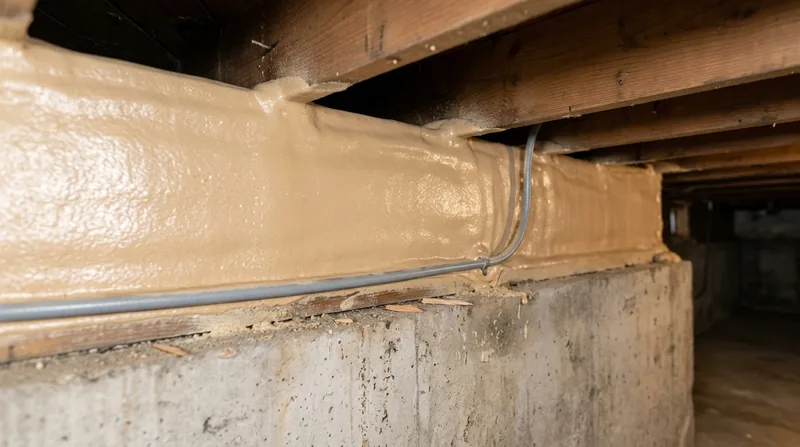




Closed cell spray foam insulation in Rockford delivers rigid, high-density protection where moisture control matters most. Rockford's heating season runs eight months, and the cold-humid climate of zone 5A pushes warm moist air outward through walls and ceilings all winter. Early-1900s balloon-frame homes near downtown, mid-century ranches scattered across the city, and newer subdivisions in Loves Park and Machesney Park all share the same vulnerability: rim joists and basement walls that leak heat and let cold air in. Closed cell foam stops that movement by creating a continuous vapor retarder that resists moisture while adding rigid R-value per inch. We build this layer thick enough to protect your home from Rockford to Belvidere, holding the heat in and the cold out through the long season.
Why Closed Cell Spray Foam Matters in Rockford's Climate
Rockford's winter is long, and the air leaks that drain energy fastest are at the ceiling plane and rim joist. Fiberglass batts and blown-in cellulose do not stop air movement, they only slow conductive heat loss. Closed cell foam seals the air gap itself while delivering R-6 to R-7 per inch, so a 2-inch layer gives you both the air barrier and meaningful insulation without the thickness open cell requires. Basement walls and rim joists stay cold in older homes even when the main floor feels warm, because the band joist is uninsulated or under-insulated and air flows freely around the block or rim board. Closed cell foam fixes that by adhering to the masonry or rim board, filling voids, and blocking the convection loop that lets basement air temperature drive the main floor cold underfoot.
- We seal rim joists and band joists with closed cell foam to stop the convection loop that keeps basements cold all winter.
- We apply closed cell to basement walls below grade, where the vapor pressure is highest and moisture moves inward from the soil.
- We use closed cell on sealed or unvented attic decks where the roof assembly must resist moisture year-round without venting.
- We spray closed cell on metal building walls and pole barn structures where condensation on steel is the dominant failure mode.
- We inject closed cell into existing wall cavities of pre-1980 homes to retrofit air sealing without demolition.
Each of these applications solves a specific moisture or air-leakage problem that Rockford's climate creates. Closed cell is not the answer for every attic, but where vapor control and air sealing must work together, it is the right tool.
Local example: A 1950s ranch in Winnebago with a full basement and an uninsulated rim joist loses 15 to 20 percent of its heating energy through that single detail. Closed cell foam, 2 inches thick around the perimeter, cuts that loss by 60 percent and warms the first-floor rooms that sit above it within days of completion.
For more on how air sealing works alongside insulation, see our air sealing service page. Illinois law requires that you verify your contractor's insurance and registration with your local building department, and we encourage you to do so for any spray foam installer, including us.
How We Install Closed Cell Spray Foam in Rockford Homes and Buildings
Closed cell installation begins with a site walkthrough to identify the substrate, any moisture sources, and the scope of air sealing needed. We measure the space, note any penetrations or obstructions, and give you a written estimate with R-value and thickness specified in board feet. The crew arrives with equipment, masks, and proper ventilation setup. We do not spray over wet, contaminated, or actively leaking substrates, period. If we find moisture or damage, we walk away and recommend a fix before we return.
- We inspect the substrate for moisture, contamination, and any active leaks or water damage before we begin.
- We seal seams, gaps, and penetrations with foam or caulk so the closed cell layer bonds to a clean, dry surface.
- We spray closed cell in controlled passes, building thickness gradually to avoid over-application and shrinkage.
- We maintain proper drum temperature and manufacturer mix ratio throughout the job, verified by our equipment.
- We run mechanical ventilation during application and for the duration of the cure cycle, typically 24 to 48 hours.
- We schedule your re-entry after the cure window closes and the space is safe for normal use.
This process takes precision. Rushed application, skipped ventilation, or immediate re-entry are the hallmarks of rig-and-run crews and are exactly what we do not do.
Rockford example: A Loves Park home with a sealed attic deck and cathedral ceiling gets 2 inches of closed cell over the rafters, 1 inch around the rim joist, and foam injected into the wall cavities above the rim. The entire job takes one day, ventilation runs for two days, and the homeowner re-enters after 48 hours. The result is a tight, dry attic and warm upstairs rooms that no longer feel drafty.
For attic-specific closed cell work, see our attic spray foam insulation page. For rim and band joist work, visit our rim joist service page.
| Approach | Description | Best for |
|---|---|---|
| Closed cell rim joist and band joist | 1 to 2 inches of closed cell foam applied directly to the rim board and band joist, filling voids and blocking air infiltration. | Basements that stay cold, first-floor rooms with drafty baseboards, convection loops that no amount of attic insulation fixes. |
| Closed cell sealed attic deck | 2 to 3 inches of closed cell sprayed on the roof decking of a sealed or cathedral ceiling attic, creating a continuous air and vapor barrier. | New construction, retrofits of vented attics to sealed, homes with moisture or ice dam history, unvented roof assemblies. |
| Closed cell basement wall retrofit | 1.5 to 2 inches of closed cell foam applied to below-grade masonry walls, resisting inward moisture drive and adding R-value. | Finished or finishing basements, moisture concerns below grade, homes in areas with high water table or clay soil. |
| Closed cell metal building and pole barn | 2 to 3 inches of closed cell on steel walls and roof decking, preventing condensation and thermal bridging on the metal structure. | Barndominiums, pole barns, metal buildings, agricultural structures, anywhere steel condensation is the dominant failure mode. |
| Closed cell wall cavity injection | Closed cell foam injected into existing wall cavities of pre-1980 homes through small holes, filling voids without demolition. | Balloon-frame homes near downtown Rockford, retrofits of homes with missing or settled insulation, air sealing without wall removal. |
Closed Cell Spray Foam Insulation Cost in Rockford: What to Expect
Closed cell spray foam starts at approximately $1.20 per board foot for straightforward applications on accessible substrates. A 500-board-foot rim joist job typically runs $600 to $800 before any site-specific adjustments. A sealed attic deck of 1,200 board feet might run $1,400 to $1,800. The price moves up when the substrate is difficult to access, contaminated, or requires extensive prep work. Moisture or active leaks require remediation before we spray, and that cost is separate. Metal buildings and barndominiums with complex geometry or large square footage are quoted on site because the board-foot count and access determine the final number.
We provide written estimates with R-value and thickness specified in board feet, so you know exactly what you are paying for. We do not quote a price per square foot or a flat rate without seeing the job. Two or three estimates from different contractors give you a realistic market range and help you spot the outliers. The cheapest bid is often the one with no ventilation plan, no re-entry window, and no insurance verification. Get our estimate free at (815) 706-6507, and compare it to others. For a full pricing overview and examples, see our pricing page.
Closed Cell Spray Foam Insulation Near Me: What Rockford Homeowners Should Know When Hiring
Hiring a spray foam contractor is not like hiring a tree service or a roofer. The work is inside your home, it involves chemicals and ventilation, and the quality of the installation affects your indoor air quality and long-term energy performance. Start by asking for proof of insurance and verification of registration with your local building department. Rockford, Loves Park, Machesney Park, Belvidere, and other towns in the area have different permitting and registration requirements, so always check with your city before work begins. Get multiple estimates, not just price but also a written scope that names the R-value, thickness in inches, the board-foot count, and the ventilation plan during cure. References from recent jobs matter, but so does a contractor who will walk away from a wet or contaminated substrate instead of spraying over it.
- Verify insurance coverage with the contractor and ask to see the certificate before work starts.
- Check your local building department website to understand what permits and contractor registration apply to spray foam work at your address.
- Get written estimates that specify R-value, thickness, board feet, and the ventilation schedule during the cure window.
- Ask about the contractor's response time if you have questions or concerns after the job is complete.
- Avoid any contractor who promises immediate re-entry, sprays without ventilation, or quotes a price so far below market that it raises flags.
The right contractor for closed cell spray foam in Rockford is one who knows the local building stock, respects the climate, and treats the installation as a precision job, not a volume play. Contact us for a free estimate and ask any questions you have about our process, insurance, and references.
Closed Cell Spray Foam Insulation in Rockford: Pricing Guide
| Service | Price | Details |
|---|---|---|
| Rim joist and band joist sealing | Starting at $1.20/board ft | Typical rim joist job runs 300 to 600 board feet depending on home size and perimeter length |
| Sealed attic deck or cathedral ceiling | Starting at $1.20/board ft | Larger jobs, 1,000 to 2,000 board feet typical; accessibility and roof pitch affect final cost |
| Below-grade basement wall | Starting at $1.20/board ft | Moisture assessment required first; contamination or active leaks add remediation cost before foam application |
| Wall cavity injection retrofit | Starting at $1.20/board ft | Pre-1980 homes with balloon frames or settled insulation; access holes and cavity condition drive board-foot count |
| Metal building or pole barn | On estimate | Requires on-site measurement due to complex geometry, steel condensation concerns, and variable access |
| Free written estimate | No obligation | Response within 24 hours at (815) 706-6507; includes R-value, thickness, and board-foot specification |
Indicative pricing, the exact cost depends on square footage, finish, and site access. Free personalized estimate within 24h at (815) 706-6507.


