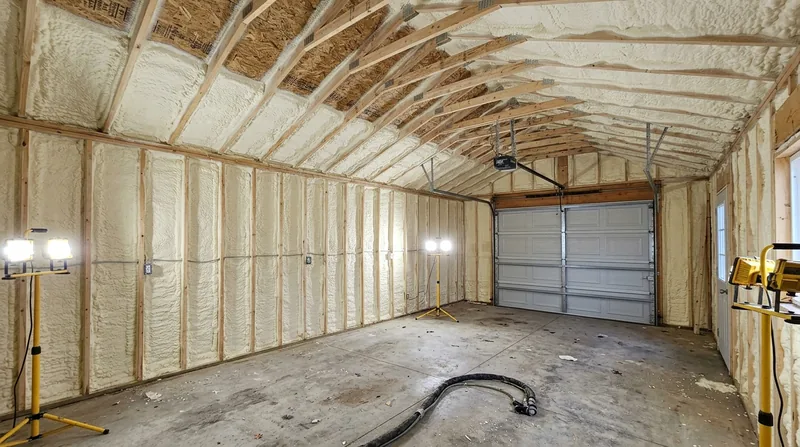




Garage spray foam insulation in Rockford transforms an uninsulated or poorly sealed garage from a cold, drafty space into one that stays usable through the long Winnebago County winter. Garages across the city sit exposed on three or four sides, taking the same brutal cold and wind that freeze the rest of the house, but most are insulated far less than the living spaces they sit beside. A detached garage or an attached space that opens to the main house becomes a thermal weak point, leaking heat through thin walls and uninsulated ceilings, and pulling warm air out of the home through shared rim joists and door frames. We spray closed cell or open cell foam across garage walls, ceilings, and rim joists to seal air leaks, raise the interior temperature by 15 to 25 degrees on a winter day, and keep workshops, hobby spaces, and attached garages functional from November through March. The result is a tighter building envelope, lower heating bills for the home, and a space where you can actually work or park without your breath freezing.
Why Garage Insulation and Air Sealing Matter in Rockford's Cold Climate
Rockford sits in IECC climate zone 5A, a region of long, cold heating seasons where the temperature difference between inside and outside drives relentless air movement and heat loss through every unsealed cavity and thin wall. A detached garage with uninsulated walls and ceiling can drop to 20 or 30 degrees even when the main house stays at 68 degrees, and an attached garage with poor rim joist sealing lets that cold pull directly into the home through shared walls and basement band joists. Most garages in Rockford were built to minimal code or no code at all, with single-stud walls, no rim joist insulation, and a ceiling of open joists or thin batts that have settled over decades. In winter, the temperature gradient between the heated home and the uninsulated garage creates a constant pressure to equalize, so warm, moist air from the living space migrates through the shared wall and rim joist, carrying heating dollars with it. Spray foam seals that pathway completely, stops the air movement, and keeps the garage cold but no longer a drain on the home.
- An uninsulated garage ceiling allows warm air to rise and escape, cooling the main floor above it even when that floor is heated.
- Gaps at the rim joist where the garage meets the foundation are the single largest air leak in most attached garages, pulling basement air directly into the garage and vice versa.
- Spray foam fills wall cavities completely, eliminating the air pockets and settling that fiberglass batts leave behind.
- A sealed garage also protects stored items, tools, and vehicles from temperature swings that cause rust and degradation.
- Moisture control improves because cold surfaces no longer condense the warm, humid air flowing from the home.
Sealing a garage with spray foam is one of the fastest ways to recover heating losses from an attached garage and to make a detached space actually usable in winter.
Key info: In Rockford, Loves Park, Machesney Park, and across Winnebago County, the heating season runs from October through April, and a single-degree drop in an attached garage pulls measurable warmth from the main house. Many homeowners in early-1900s homes near downtown and mid-century ranches discover that a cold garage is the reason their second floor or back bedrooms never feel warm, no matter how high they set the thermostat.
For more on how air sealing works across your whole home, see our air sealing service page.
How We Insulate and Seal Garages in Rockford
Our process starts with a walk-through to identify where air is leaking and where insulation is missing or failed. We assess the garage walls, ceiling, rim joist, and any shared walls with the main house, then recommend either closed cell or open cell foam based on the space, your budget, and what you need the garage for. We remove any old, failed, or moldy insulation before we spray, we seal all air leaks at the rim joist and shared walls first, then we apply foam to the walls and ceiling in controlled passes, maintaining manufacturer temperature and ratio specs throughout. Mechanical ventilation runs during the cure period to manage odor and VOC off-gassing, and we provide a clear re-entry timeline so you know when the space is safe to use again.
- We inspect the rim joist and band joist for gaps, cracks, and air leaks that connect the garage to the basement or crawl space below.
- We tape and seal any penetrations, rim joist gaps, and shared wall cavities before we apply foam to ensure a complete air barrier.
- We spray foam in even passes, maintaining thickness and R-value specs so the final installation meets code and our workmanship standard.
- We run exhaust ventilation during cure and provide written guidance on re-entry timing, typically 24 to 48 hours depending on foam type and ambient temperature.
- We leave the space clean and ready to use, with no residue or overspray left on tools, vehicles, or stored items.
The result is a garage that is sealed, insulated, and ready to hold temperature through the winter without pulling heat from the rest of your home.
Example: A homeowner in Machesney Park with a two-car attached garage found that her kitchen stayed cold even with the furnace running, and her heating bills climbed every winter. We sealed the rim joist, sprayed the shared wall between the garage and kitchen with closed cell foam, and insulated the garage ceiling with open cell. Her kitchen temperature rose 8 degrees, and her winter heating bills dropped by roughly 20 percent. She now uses the garage as a workshop year-round.
To see how we handle larger insulation and air sealing projects, visit our rim joist and band joist spray foam page.
Garage Spray Foam Insulation Methods and Materials
| Approach | Description | Best for |
|---|---|---|
| Closed Cell Spray Foam | High-density foam with an R-value of 6 to 7 per inch, moisture-resistant, and air-tight. Creates a vapor barrier and structural rigidity. | Garages in cold climates, rim joists, attached garages where moisture control is critical, and spaces where maximum R-value in minimal thickness is needed. |
| Open Cell Spray Foam | Lower-density foam with an R-value of 3.5 to 4 per inch, softer, and vapor-permeable. Allows moisture to move through the material and dries quickly. | Detached garages where budget is a priority, garage ceilings where sound dampening is desired, and spaces where vapor permeability is acceptable. |
| Rim Joist Sealing with Closed Cell | Targeted application of closed cell foam to the band joist and rim joist cavity, sealing the connection between the garage and foundation or basement. | All attached garages in Rockford, where the rim joist is the primary air leak path and where moisture from the basement or crawl space must be blocked. |
| Shared Wall Insulation | Spray foam applied to the interior face of a garage wall that adjoins the main house, sealing cavities and creating an air barrier between the two spaces. | Attached garages where the shared wall is uninsulated or has failed fiberglass, and where temperature control of the main house is the priority. |
Each method is chosen based on your garage layout, your heating and cooling needs, and your budget. We provide a written estimate that names the foam type, the R-value and thickness we will achieve, and the total cost so you know exactly what you are paying for.
Garage Spray Foam Insulation Cost in Rockford: What to Expect
Garage spray foam insulation in Rockford starts at around $1,200 for a basic single-car garage with open cell foam on the ceiling and walls, and typically ranges from $1,500 to $3,500 for a two-car garage with closed cell foam and rim joist sealing. The final price depends on the size of the garage, whether it is attached or detached, the condition of the existing insulation, how much rim joist sealing is needed, and whether you choose closed cell or open cell foam. A detached garage with no existing insulation and a simple ceiling spray is less expensive than an attached garage where we must seal the rim joist and shared walls to stop air leaks into the main house. If the garage has old, moldy, or failed insulation that must be removed before we spray, that adds labor and disposal cost, typically $200 to $500 depending on the volume. Travel is included in our pricing across Rockford and surrounding areas, so there is no separate mileage or call-out fee.
The best way to know what your garage will cost is to get a free, no-obligation estimate. We inspect the space, measure the square footage, assess the rim joist and any shared walls, and provide a written quote with the R-value, thickness, and total price broken down by section. Most estimates are ready within 24 hours. Call us at (815) 706-6507 or visit our pricing page for more detail on what affects your final cost.
What to Look for When Hiring a Garage Spray Foam Insulation Contractor Near Rockford
Spray foam is a high-performance product, but only when it is installed correctly. The difference between a professional installation and a poor one is not always visible to the eye, so you need to know what to ask for and what to verify before you hire. A good spray foam contractor will provide a written estimate that names the foam type, the R-value per inch, the thickness you will receive, and the total cost. They will explain whether they will remove old insulation before they spray, how they will manage ventilation during cure, and when the space will be safe to re-enter. They should be fully insured and able to provide proof of coverage. They will also be honest about what spray foam can and cannot do: it seals air leaks and insulates, but it does not fix a roof leak, a wet basement, or a moisture problem that has not been addressed first.
- Ask for a written estimate that includes the foam type, R-value, thickness in inches, and total square footage so you can compare apples to apples.
- Verify that the contractor is fully insured and ask to see a certificate of insurance before work begins.
- Get at least two or three estimates from different contractors so you can see the range of approaches and pricing in your area.
- Ask about the contractor's experience with garages in Rockford and whether they have worked on attached versus detached spaces.
- Check that the contractor will provide a written warranty on the workmanship and will explain what is and is not covered.
- Ask how they manage odor and ventilation during cure, and what the re-entry timeline is, so you can plan your schedule.
- Verify that any permits required by your city are understood and will be pulled if necessary before work begins.
A contractor who rushes through an estimate, quotes a price far below market without inspecting the space, promises immediate re-entry, or cannot provide proof of insurance is a red flag. The right contractor will take time to understand your garage, explain the process clearly, and stand behind the work with a warranty and responsive customer service. For a free estimate from a local spray foam contractor with 14 years in the trade, contact us today.
Garage Spray Foam Insulation in Rockford: Pricing Guide
| Service | Price | Details |
|---|---|---|
| Single-car garage, open cell foam, ceiling and walls | Starting at $1,200 | Includes open cell insulation on ceiling and wall cavities, basic air sealing, typical single-car footprint |
| Two-car garage, closed cell foam, rim joist sealing included | Starting at $2,100 | Closed cell walls and ceiling, sealed rim joist and band joist, attached garage thermal barrier between home and garage |
| Attached garage with shared wall and rim joist retrofit | Starting at $2,800 | Complete air sealing of rim joist, insulation of shared wall, ceiling foam, addresses primary heat loss pathway in attached spaces |
| Insulation removal and replacement | $300 to $600 | Removal of failed, moldy, or old insulation before spray, disposal included, labor-intensive but necessary for retrofit jobs |
| Travel and estimate | Included / Free | No mileage fee or call-out charge in Rockford and surrounding areas; free written estimate within 24 hours, no obligation |
Indicative pricing, the exact cost depends on square footage, finish, and site access. Free personalized estimate within 24h at (815) 706-6507.


