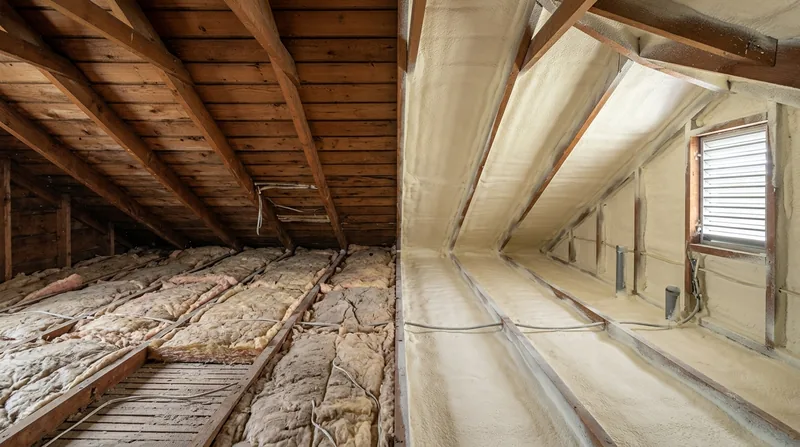




Insulation Replacement & Re-Insulation in Rockford is the remedy for attics and walls that have settled, compacted, or failed after decades of thermal cycling in climate zone 5A. Early-1900s balloon-frame homes near downtown, mid-century ranches spread across the city, and newer subdivisions in Loves Park, Machesney Park, and Roscoe all face the same problem: fiberglass batts sag, loose-fill settles, and old foam loses its seal around penetrations and rim joists. When your heating bills climb or upstairs rooms stay cold despite the furnace running, the insulation underneath is usually the culprit, not the thermostat. We remove the old material and install spray foam sized to your attic, rim joists, or walls, sealing the air leaks that fiberglass never closes. The result is a tight thermal envelope that holds heat in winter and keeps the long heating season from draining your wallet.
Why Insulation Replacement & Re-Insulation Matters in Rockford's Aging Housing Stock
Rockford's homes span three eras, and each has its own insulation failure mode. Balloon-frame homes built before 1920 have open rim joists and plaster ceilings with no air barrier at all. Mid-century ranches have full basements and attics that were insulated once, decades ago, and have settled into a fraction of their original R-value. Even newer homes built to code often sit over rim joists insulated with batts that leave gaps at the top plate and around rim band penetrations. The long, humid heating season in Winnebago and Boone counties drives warm moist air outward through these weak points, and that air leakage is what costs you money, not just the thickness of insulation that looks good on a ladder.
- Settled insulation loses 30 to 50 percent of its original R-value and allows convective air movement through the cavity.
- Fiberglass batts do not seal around electrical boxes, plumbing vents, or rim joist penetrations where air actually escapes.
- Old foam systems installed without mechanical ventilation during cure can off-gas for weeks and create odor complaints that fiberglass never does.
- Rim joists and band joists left uninsulated let cold creep into the first floor and basement, making furnace output feel wasted.
- Attics with mixed insulation types (batts over blown-in over old foam) create thermal bridging and air pockets that no amount of thickness fixes.
Replacing old insulation with spray foam eliminates these gaps and creates a continuous thermal barrier that holds its R-value year after year.
Key info: A 1,500 square foot attic in Rockford that was insulated in the 1980s with fiberglass batts now sits at R-13 due to settling and moisture absorption. Replacing it with 5.5 inches of closed-cell foam restores R-38 and seals every rim joist, top plate, and penetration in a single pass. For details on what the Illinois Building Code requires at your address, contact your local building department or see the Illinois Department of Financial and Professional Regulation.
How Insulation Replacement & Re-Insulation Works: Our Process in Rockford
Replacement insulation is not a one-step job. We start by removing the old material safely, then seal all air leaks before spraying new foam. The removal phase is critical: if old insulation is wet, moldy, or contaminated, we stop and refer you to the appropriate specialist. Once the substrate is clean and dry, we apply foam at the correct thickness and ratio, maintain proper drum temperature, and run mechanical ventilation during cure and for a full 24 to 48 hours after. This is where the difference between a local shop and a rig-and-run crew shows itself. We do not promise immediate re-entry or skip the ventilation window.
- We schedule an on-site inspection to assess the existing insulation, identify moisture or contamination, and measure the attic, walls, or rim joist cavities.
- We provide a written estimate with R-value and thickness specifications so you know exactly what you are paying for and what your final assembly will perform.
- We remove old insulation, air-seal any cracks or gaps in the rim band and ceiling plane, and repair or replace damaged substrate before foam is applied.
- We spray foam at the manufacturer's specified ratio and temperature, controlling thickness per pass to prevent overspray and off-gassing.
- We run mechanical ventilation continuously during cure and for 24 to 48 hours after application, and we provide a re-entry window in writing.
- We inspect the final installation for coverage, thickness, and continuity before we leave the site.
This disciplined process is why spray foam replacement insulation holds its performance and why homeowners do not call us back with complaints about smell or settling.
Example: A 1970s ranch in Loves Park with a full basement and an unfinished attic had 4 inches of settled fiberglass batts over the rim joist and R-11 in the attic. We removed both, sealed the rim band with spray foam, and installed 5.5 inches of closed-cell foam over the rim joists and 6 inches of open-cell foam in the attic. The rim joist work took one day, the attic took two. The homeowner reported a 22 percent drop in heating costs the following winter and no odor or settling complaints. Learn more about rim joist and band joist spray foam insulation and how it pairs with attic work.
Insulation Replacement Methods: Closed Cell, Open Cell, and Injection Foam
Not every replacement job calls for the same foam type. Closed-cell foam is denser, carries a higher R-value per inch, and acts as a vapor barrier, making it the right choice for rim joists, sealed attics, and walls in climate zone 5A. Open-cell foam is lighter, more affordable, and breathes, making it ideal for attics where ventilation is not a concern and budget is a factor. Injection foam retrofits pre-1980 closed walls without demolition. The choice depends on your cavity, your climate zone, and what the existing structure will support.
| Approach | Description | Best for |
|---|---|---|
| Closed-Cell Spray Foam | 2 lb density, R-6.5 per inch, acts as vapor barrier and air seal in one pass. Requires mechanical ventilation during cure and a 24 to 48 hour re-entry window. | Rim joists, band joists, sealed attics, basement walls, and crawl spaces where vapor control is essential in zone 5A. |
| Open-Cell Spray Foam | 0.5 lb density, R-3.6 per inch, breathes and allows vapor to pass through. Lower cost per board foot than closed-cell, still requires ventilation during cure. | Attic cavities with proper ventilation, sound dampening applications, and budget-conscious replacements where rim joist vapor control is not the driver. |
| Injection Foam Retrofit | Low-pressure injection into closed wall cavities through small holes, no wall demolition. Fills existing cavities and seals air leaks without opening the wall. | Pre-1980 balloon-frame and platform-frame homes with closed cavities, retrofit insulation of exterior walls without interior disruption. |
| Blown-In Replacement | Cellulose or fiberglass blown over the old settled material or into open cavities. No spray equipment, lower cost, but does not seal air leaks as completely as foam. | Simple attic top-ups where the existing substrate is sound, rim joist insulation is not the concern, and budget is the primary driver. |
Each method has a place. The honest question is not which is best in general, but which is right for your home, your cavity, and your climate zone. We help you sort that out on the estimate call.
Insulation Replacement & Re-Insulation Cost in Rockford: What to Expect
Insulation replacement pricing depends on the square footage of the area being treated, the type of foam, the condition of the existing insulation, and whether removal is required. A straightforward attic top-up with old fiberglass removed and open-cell foam installed typically starts at $2,800 for a 1,000 square foot attic. Rim joist and band joist replacement across a full basement perimeter runs $1,500 to $3,500 depending on whether you are sealing a single story or a two-story home. Injection foam retrofit into closed walls is priced per linear foot of wall cavity treated, usually $8 to $15 per foot. Closed-cell foam costs more per board foot than open-cell, but delivers higher R-value per inch and vapor control that matters in zone 5A.
The factors that move cost are straightforward: attic size and access, whether existing insulation must be removed or can be left in place, the R-value target you are aiming for, and whether rim joists or walls are part of the job. A tight, accessible attic costs less per square foot than a cramped, low-clearance space or one with complicated framing. If old foam is already present and in good condition, we sometimes add new foam over it rather than tearing it out, which saves labor. If the substrate is wet, moldy, or contaminated, we walk away and refer you to the appropriate specialist. Get two or three estimates from contractors who provide written specifications with R-value and thickness, not just a price per square foot.
For a detailed breakdown of pricing by scope and method, see our full pricing page. Call us at (815) 706-6507 for a free estimate with no obligation to book.
What to Look for When Hiring a Spray Foam Insulation Contractor Near Rockford
The spray foam insulation trade has two extremes: rig-and-run crews who show up in an out-of-state trailer, spray a job in an afternoon, and disappear when the smell does not go away, and national franchises that hand the work to a subcontractor with no local accountability. A local independent shop with a Rockford address, local plates, and a phone number you can reach is the third option, and it is the one that matters. When you are comparing contractors, ask for these specifics.
- Request a written estimate that includes R-value, foam thickness in inches, square footage or board feet, and the type of foam (closed-cell or open-cell) so you can compare apples to apples.
- Ask whether the contractor runs mechanical ventilation during cure and provides a written re-entry window of 24 to 48 hours, not immediate occupancy.
- Verify that the contractor carries liability and property damage insurance, and ask for a certificate of insurance before work begins.
- Check whether permits are required at your address by calling your local building department, and confirm the contractor will help you understand what applies.
- Ask for references from recent jobs in Rockford or nearby areas, and contact at least two to ask about odor complaints, settling, or workmanship issues.
- Confirm that the contractor removes old insulation if it is wet, moldy, or contaminated, and does not simply spray over a damaged substrate.
The local contractor who can answer these questions clearly, provide written specifications, and give you a phone number you can call after the job is the one worth hiring.
Ready to get started? Contact us for a free estimate or call (815) 706-6507. We will walk you through the process, answer your questions, and provide a written specification with R-value and thickness before you commit to anything.
Insulation Replacement & Re-Insulation in Rockford: Pricing Guide
| Service | Price | Details |
|---|---|---|
| Attic Insulation Replacement (Open-Cell) | Starting at $2,800 | 1,000 sq ft attic, old fiberglass removed, 6 inches open-cell foam installed, includes air sealing |
| Rim Joist & Band Joist Replacement | Starting at $1,500 | Full basement perimeter, single-story home, closed-cell foam applied to rim band and band joist cavities |
| Injection Foam Wall Retrofit | $8 to $15 per linear foot | Closed walls in pre-1980 homes, injection without demolition, price depends on wall height and cavity accessibility |
| Attic Insulation Replacement (Closed-Cell) | Starting at $4,200 | 1,000 sq ft sealed attic, closed-cell foam at 5.5 inches for R-38, includes vapor barrier and complete air seal |
| Complex or Large-Scale Replacement | On estimate | Multi-story homes, mixed foam types, extensive removal, or structural repairs needed before foam application |
Indicative pricing, the exact cost depends on square footage, finish, and site access. Free personalized estimate within 24h at (815) 706-6507.


