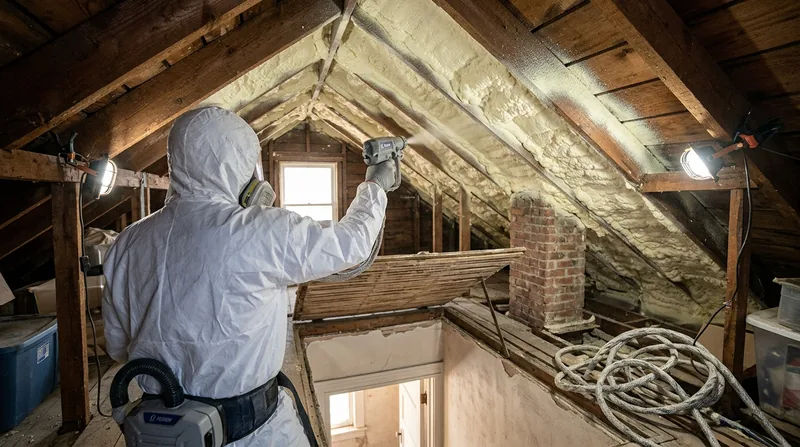




Attic Spray Foam Insulation in Rockford stops the heat loss that drives up your winter heating bills. Early-1900s homes near downtown Rockford have plaster ceilings and balloon-frame walls that leak warm air all winter. Mid-century ranches across the city sit over full basements with under-insulated attics where decades of settling have left gaps at top plates and around penetrations. Newer subdivisions in Loves Park, Machesney Park, and Cherry Valley built to more recent code still leave air leaks at the ceiling plane and rim joists untouched. In IECC climate zone 5A, the long cold heating season moves moist indoor air outward through the ceiling and wall assemblies, and those air leaks at the attic boundary are what let warm air escape and cold air in. We spray closed cell foam along the roof deck to seal the attic air barrier and stop the ceiling leaks that waste energy all season long. A properly sealed attic is the single biggest heat retention upgrade most Rockford homeowners can make.
Why Attic Insulation Fails in Rockford Homes
Plaster ceilings in early-1900s Rockford homes were never designed to be air barriers. Fiberglass batts installed decades ago have settled, leaving exposed rim joists and top plates that pull warm air straight up and out through the attic. Blown-in cellulose and fiberglass can compress under its own weight and shift away from penetrations like electrical boxes, exhaust fans, and HVAC ducts. Builder-grade insulation in newer subdivisions often leaves gaps at the perimeter where the attic meets the exterior walls. Without a continuous air seal, heating bills climb every winter no matter how much insulation sits on top.
- Plaster ceilings crack and separate from top plates, creating air leaks that grow wider each season.
- Settled fiberglass and cellulose expose rim joists and band joists that have no insulation barrier.
- Gaps around electrical penetrations, HVAC ducts, and exhaust vents stay open because blown-in insulation cannot seal them.
- Attic ventilation systems can pull conditioned air up through the ceiling plane when the air barrier is weak.
These failures are why a continuous air seal at the ceiling plane matters more than thickness alone.
Key info: A 1920s Rockford home with a plaster ceiling and original rim joists loses heat through the attic boundary faster than through the attic floor insulation itself. Sealing that boundary with closed cell foam stops the leak and cuts heating costs where the loss is greatest.
Read more about rim joist and band joist sealing, which works hand-in-hand with attic air sealing to stop heat loss at the foundation.
How Attic Spray Foam Insulation Works in Rockford
We spray closed cell foam directly onto the roof deck or along the attic floor perimeter to create a continuous air seal that stops the leaks fiberglass cannot reach. The foam expands to fill cracks, gaps, and voids around penetrations, electrical boxes, and rim joists in a single pass. Once cured, it becomes a rigid, load-bearing insulation layer with an R-value of 6.0 to 6.5 per inch. In Rockford's cold, humid climate, closed cell foam also blocks moisture movement through the assembly, which is critical because winter heating drives indoor moisture outward through the ceiling and walls. We handle mechanical ventilation during the cure process and maintain a 24 to 48-hour re-entry window before occupants return to the space.
- We inspect the attic for moisture, active leaks, or contamination and address those first or walk away.
- We seal all penetrations, rim joists, and gaps in the ceiling plane to create a complete air barrier.
- We spray closed cell foam at the correct thickness and ratio to meet your R-value target and local code.
- We ventilate the space during cure and confirm the foam has set before you re-enter the attic.
- We provide written documentation of R-value and thickness so you know exactly what you have.
The result is an attic that holds heat in winter and stays sealed against outside air.
Real example: A 1950s ranch in Winnebago with a vented attic and original fiberglass saw heating bills drop by 18 to 24 percent after we sealed the rim joist and sprayed 4 inches of closed cell foam along the roof deck. The air seal stopped the leak; the thickness provided the R-value.
For attics where the existing insulation is still sound and you just need to top it up, open cell spray foam may be a more affordable option.
Closed Cell vs. Open Cell Spray Foam for Rockford Attics
| Approach | Description | Best for |
|---|---|---|
| Closed Cell Spray Foam | High-density foam (1.5 to 2.0 lb/cu ft) with R-value of 6.0 to 6.5 per inch. Rigid and load-bearing. Blocks air and moisture movement. | Cold, humid climates like Rockford. Sealed attics. Rim joists. Crawl spaces. Wet or damp substrates. |
| Open Cell Spray Foam | Low-density foam (0.4 to 0.5 lb/cu ft) with R-value of 3.5 to 3.8 per inch. Flexible and compressible. Allows moisture vapor to pass through. | Vented attics. Sound dampening. Budget-friendly top-ups. Climates where vapor permeability is desired. |
| Blown-In Fiberglass or Cellulose | Loose-fill insulation. Does not seal air leaks or gaps around penetrations. Can settle and compress over time. | Adding thickness to a sound attic floor where air sealing is not the goal. Budget-conscious top-ups only. |
| Sealed Attic with Closed Cell | Closed cell foam sprayed on the roof deck to seal the attic boundary. Creates a conditioned attic space. Highest R-value per inch. | Rockford homes with ductwork, HVAC equipment, or finished spaces in the attic. Maximum energy performance. |
Closed cell is the right choice for Rockford's climate and the retrofit work that dominates this market.
Attic Spray Foam Insulation Cost in Rockford: What to Expect
Attic spray foam insulation in Rockford typically starts at $1.50 per square foot for a straightforward sealed attic job using closed cell foam. The final cost depends on the size of the attic, the thickness you need to meet your R-value target, access to the space, and the condition of the substrate. A 1,500-square-foot attic with a sound roof deck and clear access might cost between $2,250 and $3,000. An older home with a plaster ceiling, rim joist sealing, and penetrations to address will be higher because the prep work and air sealing take longer. If you need to remove old insulation first, that adds cost and time, but it is often necessary to ensure the foam bonds to a clean substrate. Getting 2 to 3 written estimates with R-value and thickness specifications lets you compare apples to apples and avoid low-ball offers that cut corners on ventilation, ratio, or documentation.
Visit our pricing page for detailed breakdowns by service type and region.
Attic Spray Foam Insulation Near Me: What Rockford Homeowners Should Know Before Hiring
Not all spray foam contractors are equal. Some operate as rig-and-run crews from out-of-state trailers, spray a job in an afternoon, and disappear when the smell lingers or the foam does not cure right. Others are national franchises with premium pricing and no local accountability. The strongest position is a local independent shop with a Rockford address, local insurance verification, and the willingness to walk away from a job if the substrate is wet or contaminated. Before you hire, ask any contractor for their fully insured certificate and verify it directly with their insurance carrier. Request a written estimate that includes R-value per inch, total thickness, and the square footage being treated. Ask about their ventilation setup during cure and the re-entry window they guarantee. Check references from recent jobs in Rockford, Loves Park, or Machesney Park, and ask those homeowners about the smell, the timeline, and whether the crew cleaned up afterward. Permitting and thermal barrier requirements vary by city and building department, so confirm what applies at your address before work begins. If you have an HOA in a master-planned community, check whether exterior work on sealed attics requires architectural approval. Call us at (815) 706-6507 for a free, no-obligation estimate and honest guidance on whether your attic needs spray foam or a simpler fix.
Contact us today for a written estimate with R-value and thickness specifications.
Attic Spray Foam Insulation in Rockford: Pricing Guide
| Service | Price | Details |
|---|---|---|
| Sealed Attic (Closed Cell Foam) | Starting at $1.50/sq ft | Spray closed cell foam on roof deck to seal attic boundary. Cost varies by attic size, thickness needed, and substrate condition. |
| Attic Air Sealing + Rim Joist Sealing | Starting at $2,000 | Seal ceiling plane, penetrations, and rim joists to stop air leaks. Exact cost depends on attic perimeter and number of penetrations. |
| Insulation Removal + Spray Foam | On estimate | Remove old batts or blown-in insulation before spraying foam. Removal adds labor and disposal cost based on attic volume and condition. |
| Open Cell Spray Foam (Vented Attic) | Starting at $1.00/sq ft | Lower-cost foam option for vented attics where air sealing is not the goal. Best for adding R-value to sound existing insulation. |
| Travel and Free Estimate | Included in Rockford area | No separate mileage fee or travel charge within Rockford and surrounding service areas. Free written estimate within 24 hours. |
Indicative pricing, the exact cost depends on square footage, finish, and site access. Free personalized estimate within 24h at (815) 706-6507.


