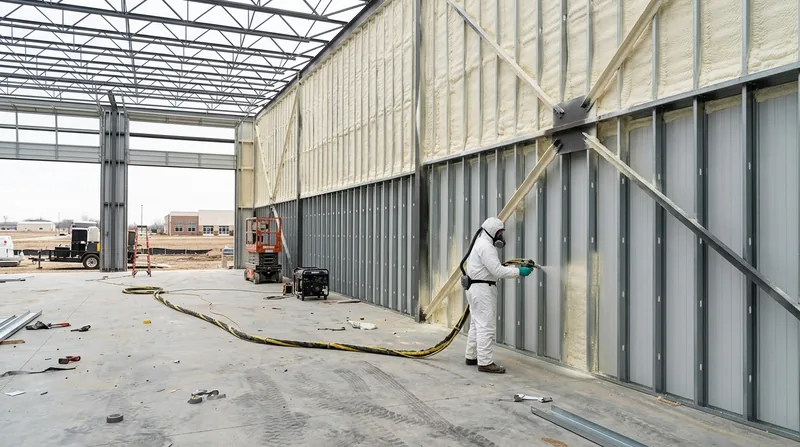




Commercial and new construction spray foam insulation in Rockford requires planning before the walls close in. Builders across Loves Park, Machesney Park, Winnebago and Cherry Valley know that an air barrier installed during framing saves money and headaches later. In IECC climate zone 5A, where the heating season runs long and moist interior air moves outward through wall and ceiling assemblies all winter, the difference between a tight building envelope and a leaky one is measured in utility bills and occupant comfort. We work with general contractors and developers to spray foam the rim joists, band joists, top plates, and any irregular cavities before drywall goes up, so the building performs as designed.
Why Commercial Spray Foam Insulation Matters Before Drywall in Rockford
New construction and commercial builds live or die on the air barrier. Once drywall is hung and taped, you cannot go back to seal the rim joist properly or fill the gaps at the top plate where the wall meets the attic. Spray foam applied before framing closes eliminates thermal bridging at studs, seals every penetration in one pass, and creates a continuous air barrier that reduces HVAC load and improves occupant comfort from day one. In Rockford's older neighborhoods near the river and in newer subdivisions stretching toward Belvidere, the buildings that stay warm and quiet are the ones where the builder or owner invested in the envelope first.
- We spray rim joists and band joists before the basement or crawl space is closed, stopping the cold-floor problem that plagues many Rockford basements.
- We seal top plates and wall cavities where studs meet the roof deck, preventing warm moist air from leaking into the attic.
- We fill irregular cavities around mechanical penetrations, ductwork chases, and structural members that batts and blown-in cannot reach.
- We work on the builder's schedule, typically after framing and before drywall, so the job does not delay the trades.
Spray foam installed at the right stage of construction is cheaper per board foot than retrofit work and delivers better performance because the substrate is clean and dry.
Key info: A new two-story home in Loves Park with a full basement and attic typically requires 800 to 1,200 board feet of closed-cell foam at the rim joists, top plates, and attic band joists. Getting this right before drywall means no callbacks for drafty rooms or thermal bridging issues later.
For more on how spray foam seals the building envelope, see our guide to air sealing in Rockford.
Illinois building officials and the state energy code require permits for new construction insulation in most jurisdictions. Check with your local building department in Rockford, Loves Park, Machesney Park, or your specific city for permit requirements and thermal barrier or ignition barrier rules that apply to your project.
How We Approach Commercial and New Construction Spray Foam in Rockford
Our process starts with a site walk during framing, before any drywall is hung. We identify rim joists, band joists, top plates, mechanical chases, and any irregular cavities that need foam. We coordinate with your general contractor to schedule the spray during the window when the frame is closed but the interior is still open. We bring our equipment and crew, spray the foam to the specified thickness and R-value, ensure proper ventilation during cure, and get out of the way so the next trade can move in.
- We meet with the GC and review the framing plan to identify all areas that need foam before we arrive on site.
- We spray closed-cell foam at rim joists and band joists to create a vapor barrier and air seal in one step.
- We apply foam to the specified thickness in multiple thin passes, never overfilling or creating voids that compromise the air barrier.
- We maintain mechanical ventilation during cure and enforce a 24 to 48 hour re-entry window so the building can be occupied safely.
- We provide written documentation of board footage, R-value, and thickness so the GC and building official have a record for the permit file.
Coordinating spray foam with the construction schedule is the key to keeping the job on time and on budget.
Example: A 12,000 square foot commercial warehouse shell in Rockford needed the rim joist and roof deck sealed before the roof was installed. We sprayed 2 inches of closed-cell foam on the rim (R-13), 1.5 inches on the roof deck (R-10), and worked around the steel structure without interfering with the roofer's schedule. The building stayed dry and the air barrier was verified before drywall and mechanical rough-in.
For details on our closed-cell spray foam insulation, see that service page.
Commercial and New Construction Spray Foam Methods in Rockford
| Approach | Description | Best for |
|---|---|---|
| Closed-cell rim and band joist spray | 2 to 3 inches of high-density closed-cell foam applied to the rim and band joist before the basement or crawl space is enclosed. Creates a vapor barrier and air seal in one step. | New construction basements and crawl spaces in Rockford where moisture control and air sealing are priorities. |
| Top plate and attic band sealing | Closed-cell foam applied at the top plate where the wall meets the roof deck, sealing the gap between studs and the attic framing. Prevents warm moist air from leaking into the attic during winter. | Two-story homes and commercial buildings in Loves Park, Machesney Park, and Winnebago where attic air leaks are the largest thermal loss. |
| Roof deck and attic floor spray | 1 to 2 inches of open-cell or closed-cell foam sprayed on the underside of the roof deck or on the attic floor before drywall. Seals all penetrations and creates a continuous insulation layer. | Conditioned attics, sealed roof decks, and commercial buildings where the attic is part of the thermal envelope. |
| Cavity and chase filling | Spray foam applied to irregular cavities, mechanical chases, and structural voids that batts and blown-in cannot reach. Fills gaps around ductwork, electrical chases, and post-and-beam members. | New construction buildings with complex framing, metal buildings, and barndominiums where every cavity must be sealed and insulated. |
| Exterior wall cavity spray (retrofit) | Closed-cell or open-cell foam injected into existing wall cavities via small access holes. Fills voids left by settling batts or blown-in insulation without removing drywall. | New construction buildings where wall cavities need to be filled before drywall is hung, or retrofit situations where cavity depth and moisture profile support injection. |
Commercial and New Construction Spray Foam Cost in Rockford: What to Expect
The cost of commercial and new construction spray foam insulation in Rockford depends on the scope of the project, the size of the building, and the areas that need foam. A free commercial estimate is the best way to get an accurate figure because spray foam is measured on site at the board foot, and the board footage varies with the rim joist height, attic dimensions, and the number of irregular cavities that need filling. Most new construction projects in the Rockford area fall into the range of $1,200 to $4,500 for a residential building and $3,000 to $15,000 or more for a commercial shell, but the exact cost depends on the specifics of your job.
Factors that affect the final cost include the total board footage of foam needed, the type of foam (open-cell or closed-cell), the height and complexity of the rim joist, the size of the attic or roof deck, and the accessibility of the areas being sprayed. A builder working on a single new home in Loves Park will pay less per board foot than a developer building multiple units because the crew can stay on site longer and amortize setup time. A commercial warehouse with a large roof deck and complex mechanical chases will require more foam and more precision than a simple residential attic.
Getting two or three estimates from different contractors is the smart move. Each estimate should include the board footage, the R-value per inch, the thickness of each application, and the total price. This lets you compare apples to apples and understand where the cost comes from. For a detailed breakdown of pricing and what affects it, see our full pricing page.
What to Look for When Hiring a Spray Foam Contractor Near Rockford
Choosing the right spray foam contractor for your new construction or commercial project is critical because the work is invisible once drywall goes up. You want a contractor who understands the local building code, coordinates with your general contractor, and delivers a clean, complete air barrier the first time. Here is what to verify before you hire anyone.
- Confirm that the contractor is fully insured with general liability and workers compensation coverage, and ask for a certificate of insurance naming your project.
- Get written estimates from at least two contractors that include board footage, R-value, and thickness specifications so you can compare scope and price.
- Ask for references from other builders or GCs in Rockford, Loves Park, or Machesney Park who have used the contractor on new construction projects.
- Verify that the contractor understands the local permit and thermal barrier requirements in your city. Illinois building codes vary by municipality, so check with your local building department.
- Ask how the contractor handles mechanical ventilation during cure and what re-entry window they enforce. Proper ventilation and a 24 to 48 hour re-entry period are the markers of a professional job.
- Confirm that the contractor will provide written documentation of board footage, R-value, and thickness for your permit file and for future reference.
A contractor who takes time to understand your project, communicates with your GC, and delivers detailed documentation is the one who will keep your job on schedule and on budget.
Ready to get started? Contact us for a free commercial estimate at (815) 706-6507. We will review your plans, walk the site, and provide a detailed scope and price.
Commercial & New Construction Spray Foam in Rockford: Pricing Guide
| Service | Price | Details |
|---|---|---|
| Free commercial estimate | Free | Site walk, framing review, board footage and R-value specifications, detailed scope of work and price |
| Residential new construction (rim joist, top plate, attic band) | Starting at $1,200 | Typical 1,500 to 2,000 sq ft home with full basement and attic, closed-cell foam at rim and top plate |
| Commercial shell or large building (warehouse, retail, office) | Starting at $3,000 | Roof deck, rim joist, mechanical chases, and irregular cavities; final cost depends on total square footage and foam type |
| Barndominium or metal building insulation | Starting at $2,500 | Steel frame, condensation control, roof deck and wall cavity spray; price varies with building size and foam specifications |
| Travel and scheduling | Included | No separate mileage fee or travel charge within Rockford and surrounding service areas |
Indicative pricing, the exact cost depends on square footage, finish, and site access. Free personalized estimate within 24h at (815) 706-6507.


