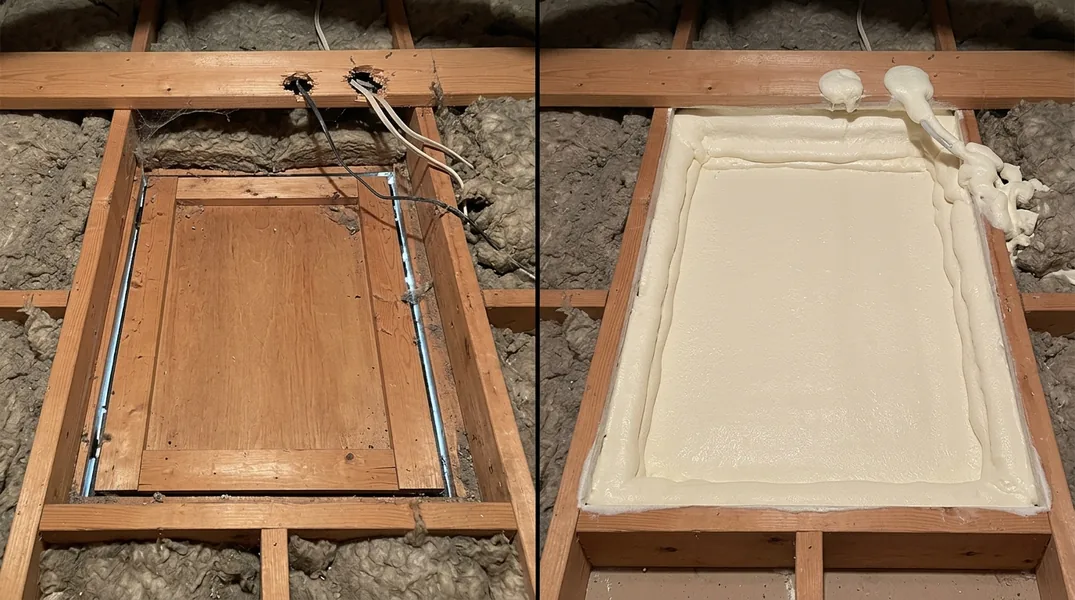
Understanding the Difference: Air Sealing vs. Full Foam Installation
When homeowners in Rockford start thinking about improving their attic insulation, they often face a critical decision: should they invest in air sealing alone, or go all-in with spray foam insulation? The answer depends on your current situation, budget, and long-term energy goals.
Air sealing focuses on closing gaps, cracks, and penetrations where conditioned air escapes. It's typically done using caulk, weatherstripping, or foam sealant around electrical outlets, ductwork, and rim joists. This approach addresses one of the biggest energy losses in homes, since air leakage can account for 25 to 40 percent of heating and cooling energy loss. However, air sealing alone doesn't add insulation value or R-value to your attic. It simply stops the air from moving where it shouldn't.
Full Attic Spray Foam Insulation takes a more comprehensive approach. Spray foam simultaneously seals air leaks and provides insulation in one application. When applied correctly, it expands to fill cavities, cracks, and gaps while creating a continuous thermal and air barrier. This dual benefit makes spray foam a popular choice for homeowners who want maximum energy efficiency and comfort.
Spray Foam Insulation R Value Per Inch: What You Need to Know
Understanding R-value is essential when evaluating insulation options. R-value measures thermal resistance, with higher numbers indicating better insulation performance. The R-value per inch varies significantly depending on the type of spray foam you choose.
Closed Cell Spray Foam Insulation delivers approximately 6.0 to 6.5 R-value per inch, making it the most efficient spray foam option available. This higher density foam is ideal for attics where space is limited or where you need maximum performance in a thinner application. Closed cell foam also provides superior moisture resistance and structural strength, which can be valuable in older homes or those in humid climates.
Open Cell Spray Foam Insulation typically offers 3.5 to 3.6 R-value per inch. While this is lower than closed cell, open cell foam is more affordable and still provides excellent air sealing properties. It's also lighter and more flexible, which some contractors prefer for certain applications. For most attics in the Rockford area, open cell foam provides a solid balance of performance and cost-effectiveness.
The choice between these two types often comes down to your specific needs and budget. A qualified insulation contractor can assess your attic and recommend the best option for your home's unique circumstances.
R Value Requirements by State: Meeting Illinois Standards
Illinois has specific insulation requirements that vary based on your climate zone and the part of your home being insulated. Understanding these requirements ensures you're not only meeting code but also maximizing your home's energy efficiency and potential resale value.
For attic insulation in Illinois, the current recommended R-value is R-38 to R-60, depending on your specific location and heating degree days. Rockford falls in a climate zone that typically requires R-49 for new construction and R-38 as a minimum retrofit standard. This means if you're upgrading your existing attic, you should aim for at least R-38, though R-49 provides better long-term energy savings and comfort.
To achieve R-38 with closed cell spray foam, you'd need approximately 6 inches of material (since it provides about 6.5 R-value per inch). With open cell foam, you'd need around 10 to 11 inches to reach the same R-value. These calculations are important when determining how thick your spray foam application should be. Meeting or exceeding state requirements can also qualify you for energy efficiency tax credits and rebates, which we'll explore in the next section.
How Thick Should Spray Foam Be? Finding the Right Application Depth
The thickness of your spray foam insulation directly impacts both its R-value performance and your overall project cost. There's no one-size-fits-all answer, but understanding the relationship between thickness, R-value, and your home's needs will help you make an informed decision.
As mentioned earlier, achieving R-38 requires different thicknesses depending on foam type. If you're using closed cell foam, 6 inches typically gets you there. Open cell foam requires roughly 10 to 11 inches for the same performance. However, many homeowners opt to exceed minimum code requirements. Going to R-49 or even R-60 provides greater comfort, lower utility bills, and better sound dampening. With closed cell foam, R-49 requires about 7.5 inches, while open cell needs approximately 14 inches.
Your attic's existing conditions also matter. If you already have some fiberglass or cellulose insulation, your contractor may recommend applying spray foam over it rather than removing it completely. This layering approach can be cost-effective while still achieving your target R-value. The key is ensuring proper ventilation if you're combining materials and avoiding moisture problems. Your contractor will assess your attic's structure, ventilation, and current insulation to recommend the optimal thickness for your specific situation.
Insulation Tax Credit and Rebates: Making Your Project More Affordable
One of the most attractive aspects of investing in spray foam insulation is the potential for tax credits and energy rebates. The federal government and many state programs offer financial incentives to homeowners who improve their home's energy efficiency, which can significantly offset your initial investment.
The federal insulation tax credit allows you to claim up to 30 percent of the cost of qualifying insulation improvements, with a maximum credit of $3,200 per year (as of recent tax years). To qualify, your spray foam installation must meet specific performance requirements, which is why working with a certified contractor like Rockford Spray Foam Insulation is important. Your contractor should provide documentation proving that your installation meets or exceeds the required R-value and performance standards.
Illinois also offers various utility rebates through programs like ComEd and Ameren. These programs provide direct rebates for attic insulation upgrades that reduce energy consumption. Rebate amounts vary but can range from a few hundred to over a thousand dollars, depending on your current insulation level and the improvement you're making. Some programs even offer instant rebates at the point of installation, reducing your out-of-pocket costs immediately.
When you request a free estimate from Rockford Spray Foam Insulation at (815) 706-6507, our team can help you understand which rebates and tax credits you may qualify for. We'll provide the documentation needed to claim these incentives, making your investment in energy efficiency even more attractive.
Making Your Decision: Is Spray Foam Right for Your Rockford Home?
Deciding between air sealing alone and full spray foam insulation comes down to several factors: your current insulation level, your energy goals, your budget, and your timeline. If your attic has minimal insulation and significant air leakage, spray foam offers the most comprehensive solution. It addresses both problems simultaneously and provides lasting performance for decades.
If your attic is already reasonably well-insulated but has noticeable drafts or cold spots, strategic air sealing might be a more cost-effective starting point. However, many homeowners find that once they understand the benefits of spray foam, the additional investment pays for itself through energy savings and increased comfort within just a few years.
The best way to determine what your Rockford home actually needs is to have a professional energy audit and consultation. Rockford Spray Foam Insulation offers comprehensive assessments at no charge. Our team will evaluate your attic, discuss your concerns, explain your options, and provide transparent pricing for the work. Whether you ultimately choose air sealing, spray foam, or a combination approach, you'll have the information needed to make the right decision for your home and budget. Contact us today at (815) 706-6507 to schedule your free estimate.
Looking for a professional spray foam insulation contractor in Rockford? Rockford Spray Foam Insulation responds fast for all your spray foam insulation needs.
Get a Free Quote