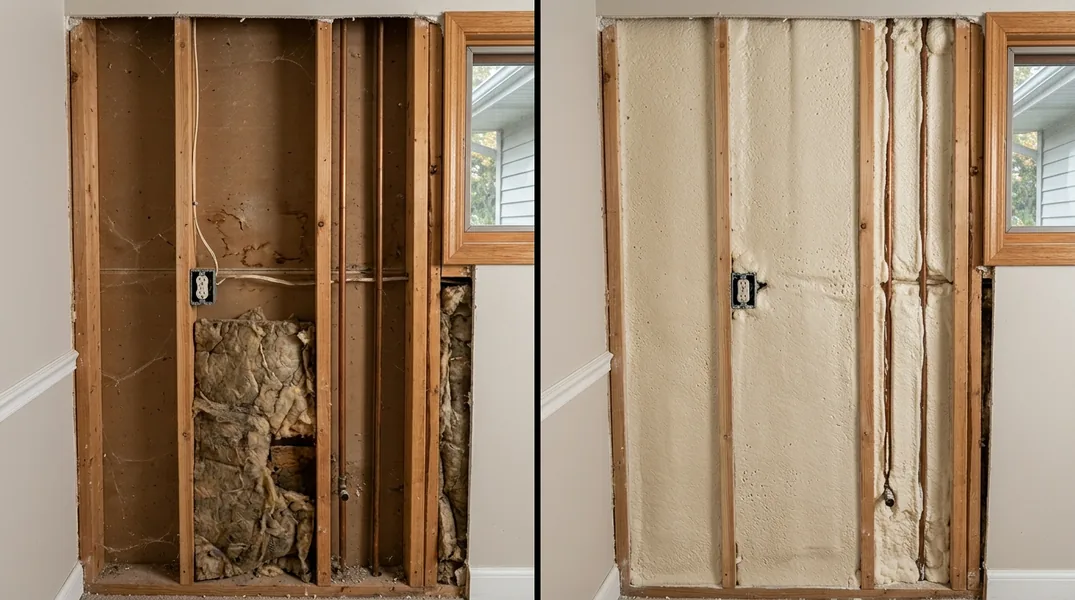
The Mid-Century Ranch Attic Challenge in Rockford
Walk into the attic of a typical mid-century ranch home across Rockford, and you'll likely find one of two scenarios: either minimal insulation that has settled and compressed over decades, or a patchwork of materials added during various renovation phases. These charming homes, built primarily between the 1940s and 1970s, were constructed to different energy standards than today's climate-conscious building codes. Back then, insulation was an afterthought compared to structural integrity and aesthetics.
The problem compounds with time. Original fiberglass batts have sagged, blown-in cellulose has compacted, and air leaks have multiplied around ductwork, electrical penetrations, and roof eaves. Homeowners in Rockford who inherited or purchased these properties often notice skyrocketing utility bills, uneven room temperatures, and ice dams in winter. The attic, which should be a thermal barrier protecting your living space, has become a liability. Understanding your options for upgrading attic insulation is the first step toward reclaiming comfort and efficiency in your home.
Spray Foam vs Blown-In Insulation: Performance and Durability
When comparing Attic Spray Foam Insulation to blown-in options, the differences in performance are significant. Spray foam, whether open-cell or closed-cell, expands to fill cavities completely, sealing air gaps that blown-in materials simply cannot address. Blown-in insulation (typically cellulose, fiberglass, or mineral wool) is pneumatically distributed across the attic floor, but it settles over time and leaves voids around irregular framing, pipes, and wiring. This means your effective R-value decreases year after year, while spray foam maintains its thermal resistance indefinitely.
Durability is another critical factor. Blown-in insulation requires periodic inspection and top-ups as it compacts. It's also vulnerable to moisture absorption, which reduces effectiveness and can promote mold growth in humid climates. Closed Cell Spray Foam Insulation creates a moisture barrier as it cures, protecting your attic structure and maintaining consistent performance for 80+ years. Open Cell Spray Foam Insulation offers excellent sound dampening and is more affordable, though it's vapor-permeable and better suited to certain climate zones. For Rockford homeowners seeking a long-term investment, spray foam delivers superior durability and consistent performance.
Spray Foam vs Fiberglass: Why Modern Homes Are Making the Switch
Fiberglass batts were the gold standard for decades, and you'll find them in virtually every mid-century ranch attic. They're inexpensive, easy to install, and have a familiar R-value rating. However, fiberglass has several inherent limitations that spray foam overcomes. Fiberglass requires perfect installation to achieve its rated R-value, and any gaps, compression, or moisture exposure significantly reduces effectiveness. Additionally, fiberglass does nothing to seal air leaks, meaning conditioned air escapes through countless cracks and openings in your attic.
Spray foam, by contrast, creates an air-tight seal while simultaneously providing insulation. A single application of spray foam addresses two critical energy problems at once: it insulates and it air-seals. This dual benefit means lower heating and cooling costs, better humidity control, and fewer drafts. Fiberglass also deteriorates faster in attics with moisture issues, which is common in older homes where ventilation systems may be inadequate. Homeowners comparing these options often discover that the upfront cost difference is offset within 3 to 5 years through energy savings alone.
Spray Foam vs Cellulose: The Moisture and Settling Question
Cellulose insulation, made from recycled paper, is an eco-friendly and affordable blown-in option that many homeowners consider. It offers a higher R-value per inch than fiberglass and is denser, which provides some air-sealing benefits. However, cellulose has a critical weakness: it's hygroscopic, meaning it absorbs moisture readily. In an attic with any roof leaks, condensation issues, or high humidity, cellulose can degrade, support mold growth, and lose R-value. Treating cellulose with fire retardants helps, but doesn't eliminate moisture sensitivity.
Spray foam eliminates these concerns entirely. Because it expands and hardens into a solid mass, it doesn't absorb water and won't support mold or pest infestations. It also doesn't settle or compress like cellulose, so your R-value remains constant throughout the life of your home. For homeowners in older Rockford properties where moisture control is uncertain, spray foam provides peace of mind. The material is chemically stable and won't degrade, making it the best insulation for attic spaces where durability and reliability are priorities. If you're weighing cellulose against spray foam, ask yourself: do you want to inspect and maintain your insulation every few years, or install it once and forget about it?
Best Insulation for Attic: Why Spray Foam Wins for Mid-Century Homes
Determining the best insulation for attic spaces depends on your home's specific needs, but spray foam consistently outperforms alternatives for mid-century ranches. These homes typically have irregular framing, older ductwork, and outdated ventilation systems that create numerous air leaks. Spray foam's ability to conform to any shape and seal every gap makes it ideal for retrofitting older structures. It also works seamlessly around existing obstacles, unlike blown-in materials that can't navigate tight spaces effectively.
Another advantage is energy efficiency. The Department of Energy recognizes spray foam as one of the highest-performing insulation options available, with R-values ranging from 3.6 per inch (open-cell) to 6.5 per inch (closed-cell). For attics, closed-cell spray foam provides superior performance in cold climates like Illinois, where winter heat loss is a major concern. Additionally, spray foam creates a continuous thermal envelope, preventing thermal bridging through framing members. This means your home stays warmer in winter and cooler in summer with less HVAC strain. Over the lifetime of your home, this translates to substantial energy savings, improved comfort, and a smaller carbon footprint.
Attic Spray Foam Insulation Cost in Rockford: What to Budget
Cost is understandably a primary concern for homeowners considering insulation upgrades. Spray foam typically costs more upfront than blown-in insulation or fiberglass batts. However, understanding the true cost picture requires looking beyond the initial price tag. Spray foam installation is a specialized process requiring professional equipment and trained technicians, which justifies the higher labor and material costs. For a typical mid-century ranch attic in Rockford, expect to invest more than you would for blown-in alternatives, but the performance gains and longevity justify the expense.
When evaluating pricing, consider that spray foam delivers energy savings of 15 to 30 percent on heating and cooling costs, depending on your climate and previous insulation condition. These savings accumulate year after year, and many homeowners recoup their investment within 5 to 7 years. Additionally, spray foam increases your home's resale value by improving energy efficiency ratings and reducing buyer concerns about moisture and pest infiltration. Rockford Spray Foam Insulation offers transparent pricing based on your attic's square footage and complexity. To get an accurate estimate tailored to your home, contact the team at (815) 706-6507 or request a free estimate online. Understanding your specific costs and potential savings will help you make a confident decision.
Looking for a professional spray foam insulation contractor in Rockford? Rockford Spray Foam Insulation responds fast for all your spray foam insulation needs.
Get a Free Quote